An AI upskilling program built on real work
Clustr runs AI upskilling programs for employees: live, instructor-led cohorts on ChatGPT, Microsoft Copilot, Claude, and Gemini, built on your team's actual documents and workflows, with capability baselined and measured through SINA, our AI literacy platform. Skill that shows up in the work, not a completion dashboard.
Why course libraries don't close the AI skills gap
Most AI upskilling budgets buy seats in self-paced course platforms. Completion rates and Monday-morning behavior tell you how that goes.
Watching is not doing
Video courses teach about AI. Capability comes from doing the work with AI: your documents, your data, your judgment calls, with an instructor in the room when it gets messy.
Generic skills don't transfer
Prompting tips in the abstract evaporate on contact with a real deliverable. Upskilling sticks when each role rebuilds its own highest-friction workflows in session.
Completions are not capability
A finished course proves someone clicked through. SINA measures what people can actually do, before and after, so the program is accountable for capability, not attendance.
Individual learning, organizational problem
The AI skills gap is an organizational gap. Cohorts, champions, and shared workflows turn individual skill into team capability that compounds after the program ends.
The upskilling framework
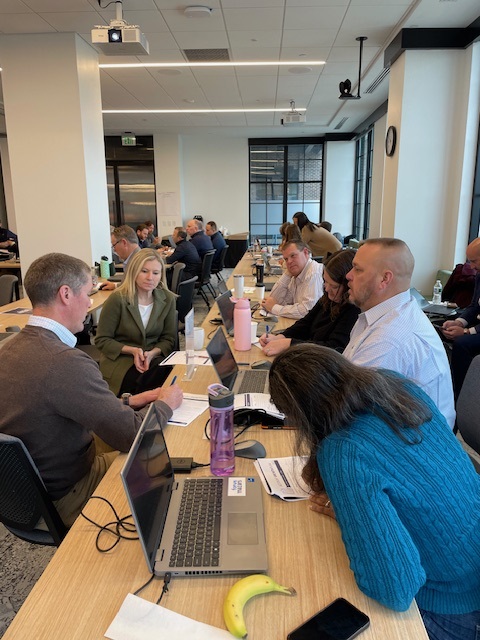
A structured path from baseline to measured capability, delivered in small cohorts with in-person kickoffs wherever we can get in the room.
Baseline skills with SINA
Every participant is assessed before the program starts. You see the skills gap by role and team, quantified, before a single session is scheduled.
Cohort-based live sessions
Small, role-based cohorts learn on their real work, on the platforms your firm licenses. Instructor-led, hands-on, and paced so nobody is left behind.
Workflow rebuilds
Each cohort rebuilds its highest-value workflows with AI in session: research, drafting, analysis, reporting. People leave with skills embedded in work they do every day.
Champions deepen the bench
Standout participants continue in weekly office hours, building advanced workflows and agentic tools, and carrying skills peer to peer across their teams.
Re-measure capability
SINA re-assessment quantifies the skill gain by person, role, and team. Leadership sees the capability curve move, and knows where to invest next.
Self-paced platforms vs an instructor-led upskilling program
Both have a place. Course platforms are cheap breadth; instructor-led programs are how capability actually forms. Here is the honest comparison.
| Self-paced course platform | Clustr upskilling program | |
|---|---|---|
| Format | Video libraries and quizzes, learner-paced | Live instructor-led cohorts, in-person first, hybrid by design |
| Material | Generic examples and sandbox exercises | Your team's real documents, deals, and workflows |
| Measure of success | Course completions and seat utilization | SINA-measured capability gain and changed daily workflows |
| After it ends | Library access renews annually | Champions, playbooks, and SINA stay with your team |
| Best for | Broad awareness at low cost per seat | Teams that need capability to show up in the work this quarter |
Adoption you can see on a chart
Every engagement is baselined with SINA, our AI literacy platform, and re-measured as the program runs. Leadership sees fluency by role, usage over time, and where to invest next.
AI adoption · pilot to daily use · 90-day program
Baselined with SINA, re-measured at week 12. Adoption is the deliverable.
Upskilling on the platforms your firm licenses
The skills are platform-specific by design: Copilot in Microsoft 365, Gemini in Workspace, ChatGPT Enterprise, and Claude, taught by people who build with each of them.

Upskilling that moved real teams
At Forvis Mazars, our regional CPE-accredited workshops upskilled 300+ professionals on Microsoft Copilot. At Cresa, a leading North American commercial real estate firm, growth and finance teams went from baseline fluency to automated daily workflows in one program, measured with SINA. We have run the same play for healthcare technology and accounting teams on Claude.
AI Upskilling, answered directly
Updated August 2026
What is an AI upskilling program?
A structured program that raises employees' ability to work with AI, measurably. Clustr's version: a SINA skills baseline, live role-based cohorts on the platforms you license, workflow rebuilds on your real work, a champions track for depth, and a re-measured capability gain at the end, typically over about 90 days.
How is this different from giving employees a course library?
Libraries deliver content; programs deliver capability. Self-paced courses are useful for broad awareness, but capability forms when people do their own work with AI under instruction, in cohorts, with measurement. Many clients run both: a library for breadth, Clustr for the teams where capability has to show up this quarter.
Which roles can be upskilled on AI?
All of them, with different curricula. Sales, finance, operations, marketing, HR, and leadership learn workflow skills on ChatGPT, Copilot, Claude, or Gemini. Engineering tracks cover agentic development with Claude Code, Codex, and Copilot Studio.
How long does AI upskilling take?
Cohorts typically run inside a program of about 90 days: baseline, live sessions in small batches, weekly office hours, and re-measurement. Meaningful skill gains show up in the first month; the program structure is what makes them stick.
How much does an AI upskilling program cost?
Scoped to cohort count, format, and depth, and priced against the AI licenses you have already bought. A short briefing is the fastest way to a number; we map your teams and recommend a scope.
How do you measure upskilling results?
With SINA, our AI literacy and assessment platform: a per-person baseline before the program and a re-measure after, plus the workflows each cohort ships. Leadership sees the capability gain by role and team, not a completion percentage.
We use cookies
We use cookies and Google Analytics to understand how visitors use our site. Privacy Policy